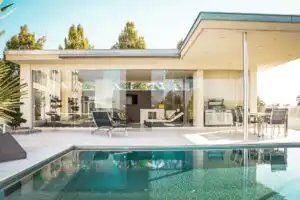
The Rodriguez family’s 1968-built mid-century modern home in Rancho Mirage was an architectural gem—clean lines, generous windows, post-and-beam construction, and authentic period design made it distinctive and desirable. However, the original kitchen felt cramped and incompatible with contemporary living standards. The challenge was transforming a dated kitchen while preserving the mid-century aesthetic that made the home special.
MasterCraft Builds completed this sensitive remodel that modernized function while honoring the home’s distinctive architectural character. The $65,000 project demonstrates how thoughtful design can enhance original architecture rather than erase it.
The Before: Original Kitchen Context
The original 1968 kitchen reflected period design principles and contemporary standards:
Architectural character: – Original knotty pine cabinetry with clean mid-century lines – Exposed beam ceiling (characteristic of 1968 construction) – Original tile backsplash with geometric patterns typical of the era – Small window above sink aligned with period design – Open floor plan connecting kitchen to dining area (progressive for 1968) – Original terrazzo countertops showing age and wear
Functional limitations: – Small work triangle with limited counter space – Original appliances (1968) were non-functional and inefficient – Inadequate storage for contemporary family needs – Single overhead light source (insufficient for modern cooking) – No dishwasher integration – Limited electrical capacity with only two countertop outlets – Poor ventilation with minimal range hood capability
Material deterioration: – Terrazzo countertops were cracked and stained – Original tile backsplash had loose tiles and grout issues – Knotty pine cabinetry showed wear; hinges were failing – Floor was original 1968 terrazzo, cracked and difficult to clean
Family priorities: 1. Modernize function (efficient appliances, proper lighting, adequate storage) 2. Preserve mid-century character (don’t eliminate the home’s distinctive aesthetic) 3. Improve workflow (optimize kitchen triangle, expand counter space) 4. Maintain visual continuity with the rest of the home 5. Achieve contemporary quality without period-specific cost
Design Philosophy: Modern Within Mid-Century
Rather than completely replacing the kitchen with contemporary design, MasterCraft Builds developed a strategy respecting mid-century principles while incorporating modern efficiency.
Design Principles
Preserve authentic elements: Original post-and-beam ceiling would remain. The exposed structure was a defining architectural feature worth preserving.
Honor period aesthetic: Color palette, material selections, and design approach would respect mid-century design language rather than contradict it.
Modernize systems: New appliances, electrical, plumbing, and lighting would meet contemporary standards while minimizing visual disruption.
Expand function: Layout modifications would improve workflow without dramatically altering the original spatial organization.
Integration strategy: New and original elements would work together, creating intentional dialogue between periods rather than obvious juxtaposition.
Layout Modifications
The original layout featured a closed-off galley between two walls. The kitchen opened to a dining area, but the division between spaces felt abrupt.
The design opened this division, creating visual and functional connection between cooking and dining areas. Rather than a dramatic wall removal, a simple lowered soffit was removed, opening sightlines while maintaining spatial definition.
Additional layout changes: – Sink repositioned to window wall, improving natural light access – New island added (4′ x 2′) creating casual dining and additional work surface – Appliance wall reconfigured for optimal triangle – Corner storage improved through angled cabinetry
Cabinetry Design and Preservation Strategy
This was the most sensitive decision: preserving authentic mid-century cabinetry versus complete replacement.
Preservation consideration: The original knotty pine cabinetry was authentic to the home and worth preserving. However, it required refinishing and selective replacement due to condition.
Strategy employed: – Retained upper cabinets (salvageable condition, authentic mid-century design) – Replaced lower base cabinets (deteriorated condition made refinishing impractical) – New lower cabinets respected mid-century aesthetic with clean lines and tapered legs
New cabinetry specifications: – Custom white oak cabinetry maintaining 1960s line proportions – Flat-panel doors without ornament (period-appropriate minimalism) – Tapered legs on base cabinets (characteristic of mid-century design) – Soft-close hinges and full-extension drawers (modern convenience within period aesthetic) – Internal organization matching contemporary needs
Preserved upper cabinets: – Original knotty pine refinished to warm honey tone – Hardware upgraded to brushed brass (period-appropriate while contemporary) – Interior reorganized with modern shelf liners and organizational systems
Cabinetry cost: $14,200 (custom new base units, refinished/enhanced uppers)
Countertop and Surface Material Selection
This was critical to balancing contemporary function with mid-century aesthetic.
Decision: Honed Calacatta marble countertops replacing cracked terrazzo
Rationale: – Marble had been used in high-end 1960s homes (period-appropriate reference) – Honed finish (matte, not polished) complements mid-century aesthetic – Calacatta marble’s subtle gray veining fits the palette – Marble carries appropriate visual weight matching original terrazzo
Backsplash approach: Rather than removing the original geometric tile backsplash entirely, selective pieces were preserved and integrated into a new design. New tile complemented original pattern while updating material: – Preserved sections of original tile in focal areas – New ceramic tile in complementary patterns filling gaps – Overall effect honors original while appearing intentionally curated – Cost: $2,100
Appliance Selection and Integration
Stainless steel appliances replaced 1968 equipment, chosen for contemporary function with period-compatible aesthetics.
Appliance selection strategy: – Clean-lined, minimalist designs compatible with mid-century aesthetic – Stainless steel finish was available in some high-end 1960s homes (appropriate reference) – Handleless drawer-style refrigerators and appliances matching period minimalism
Specific selections: – 30″ induction cooktop (flat surface, no protruding knobs—minimalist aesthetic) – Wall-mounted convection oven (clean lines, space-efficient) – 24″ refrigerator drawer (drawer-style appliances were period-contemporary) – Integrated dishwasher (hidden appliance respects visual simplicity) – Ventilation hood: Integrated into soffit above cooktop (minimal visual impact)
Appliance cost: $8,200
Lighting Design and Electrical Infrastructure
Original 1968 lighting was inadequate and stylistically dated.
Lighting strategy: – Respect mid-century design principles while providing contemporary illumination – Integrate with exposed beam ceiling rather than hiding under soffits
Lighting plan: – Recessed LED downlights integrated into ceiling (modern technology in subtle placement) – Pendant lights over island (period-appropriate hanging fixtures with contemporary internals) – Under-cabinet task lighting (essential modern addition, invisible from seating areas) – Wall sconces flanking window (1960s-style design with LED internals)
Electrical improvements: – New 20-amp circuits for appliances – Six countertop outlets replacing original two – GFCI protection throughout – Dimmer controls for ambient lighting
Lighting and electrical cost: $3,800
Flooring and Wall Finishes
The original terrazzo flooring was removed and replaced with material echoing period character.
Flooring selection: – Large-format ceramic tile (18″x18″) in warm gray-brown tone – Slightly matte finish complementing period aesthetic – Contemporary material with period-compatible color palette – Easy to maintain while durable
Wall finish: – Original wood paneling preserved where condition permitted – Problematic areas replaced with complementary finish (flat drywall painted to match) – Overall effect maintains original warmth and texture
Flooring cost: $2,800
Hardware, Fixtures, and Finishing Details
Small details significantly impact whether a kitchen feels cohesive.
Hardware strategy: – Brushed brass hardware (mid-century period staple) – Minimalist design without ornamental detail – Cabinet handles and knobs consistent throughout
Faucet selection: – Single-lever faucet with aerator (contemporary efficiency) – Brushed brass finish coordinating with cabinet hardware – Clean lines complementing kitchen aesthetic
Sink: – Undermount sink (contemporary installation method) – Stainless steel (period-compatible reference) – Large single bowl (contemporary preference for oversized workspace)
Cost: $2,100 (hardware and fixtures)
Project Execution and Timeline
The 8-week project carefully phased work to minimize disruption while managing the sensitive renovation.
Phase 1: Weeks 1-2 – Demolition and Structural Work
– Selective demolition preserving authentic elements
– Original upper cabinets carefully removed for refinishing
– Electrical rough-in work (new circuits, outlet locations)
– Plumbing adjustments for sink relocation
Phase 2: Weeks 3-4 – Infrastructure and Structural Elements
– Refrigeration system installation (floor-based system separate from cabinet)
– New base cabinetry construction and installation
– Flooring installation
– Electrical rough-in completion and inspection
Phase 3: Weeks 5-6 – Finishes and Installation
– Restored upper cabinets installation
– New countertops installation
– Backsplash tile installation
– Appliance installation and electrical connections
– Lighting fixture installation
Phase 4: Weeks 7-8 – Final Details and Completion
– Hardware installation
– Faucet and sink installation
– Final electrical connections and testing
– Paint and finish touch-up
– Final inspection and punch list
Budget and Cost Breakdown
The $65,000 project budget was maintained through careful material selection and efficient execution:
| Category | Cost | |———-|——| | Cabinetry (new and refinished) | $14,200 | | Countertops and backsplash | $4,900 | | Flooring | $2,800 | | Appliances | $8,200 | | Lighting and electrical | $3,800 | | Plumbing and fixtures | $2,100 | | Hardware and finishing | $2,100 | | Permits and inspections | $1,200 | | Design and project management | $4,500 | | Labor (installation) | $15,000 | | Contingency | $6,200 | | TOTAL | $65,000 |
*Project completed on budget with contingency unused, demonstrating efficient execution*
Results and Transformation Impact
The completed kitchen successfully modernized function while preserving mid-century character.
Functional Transformation
– Workflow efficiency: Optimized triangle reduced movement and improved cooking experience – Counter space: Doubled work surface area through island and reconfigured layout – Storage: New cabinetry provided systematic storage eliminating clutter – Lighting: Modern LED lighting provides task and ambient illumination – Electrical: Adequate outlets eliminated dangerous extension cord usage – Appliances: Contemporary efficiency (induction cooktop, convection oven) improves cooking capability
Aesthetic Transformation
The kitchen maintains its mid-century identity while feeling contemporary:
– Exposed beams remain visible, defining the space architecturally – Preserved original upper cabinets anchor the space authentically – Marble countertops add sophistication without contradicting period design – Clean-lined appliances respect minimalist mid-century aesthetics – Overall effect: A 1968 kitchen that functions like 2024, not a period recreation
Property Value Impact
The renovation increased property value by approximately $28,000-$35,000 (estimated through comparable sales of similarly-sized Rancho Mirage mid-century homes). The $65,000 investment returned 43-54% within first year—a solid return on investment.
More importantly, the family’s relationship with the home improved significantly. What had been a frustrating daily experience became a space they enjoy and take pride in.
Design Recognition
The project was featured in _Desert Modern Home_ magazine as an example of sensitive renovation respecting architectural authenticity while modernizing function—a relatively rare achievement in mid-century home renovation.
Lessons for Mid-Century Home Renovation
This project demonstrates several principles applicable to similar homes:
1. Respect authentic elements: Original mid-century features are distinctive and worth preserving 2. Honor design language: New elements should respect period aesthetic rather than contradict it 3. Modern systems, period appearance: Contemporary function (LED lighting, induction cooktop) can integrate into period design 4. Selective preservation: Some original elements warrant restoration; others warrant thoughtful replacement 5. Integration over contrast: Mixing periods successfully requires intentional dialogue rather than obvious juxtaposition
The Rodriguez kitchen exemplifies how mid-century homes can be modernized while maintaining their distinctive architectural character.
*Author: MCA Construction Group*
Modernize your mid-century home while preserving its distinctive character. Contact MasterCraft Builds for sensitive renovation consultation, mid-century design expertise, and thoughtful execution honoring your home’s architectural heritage.